

How the world’s Top 10 economies generate energy
Oil still dominates across major economies
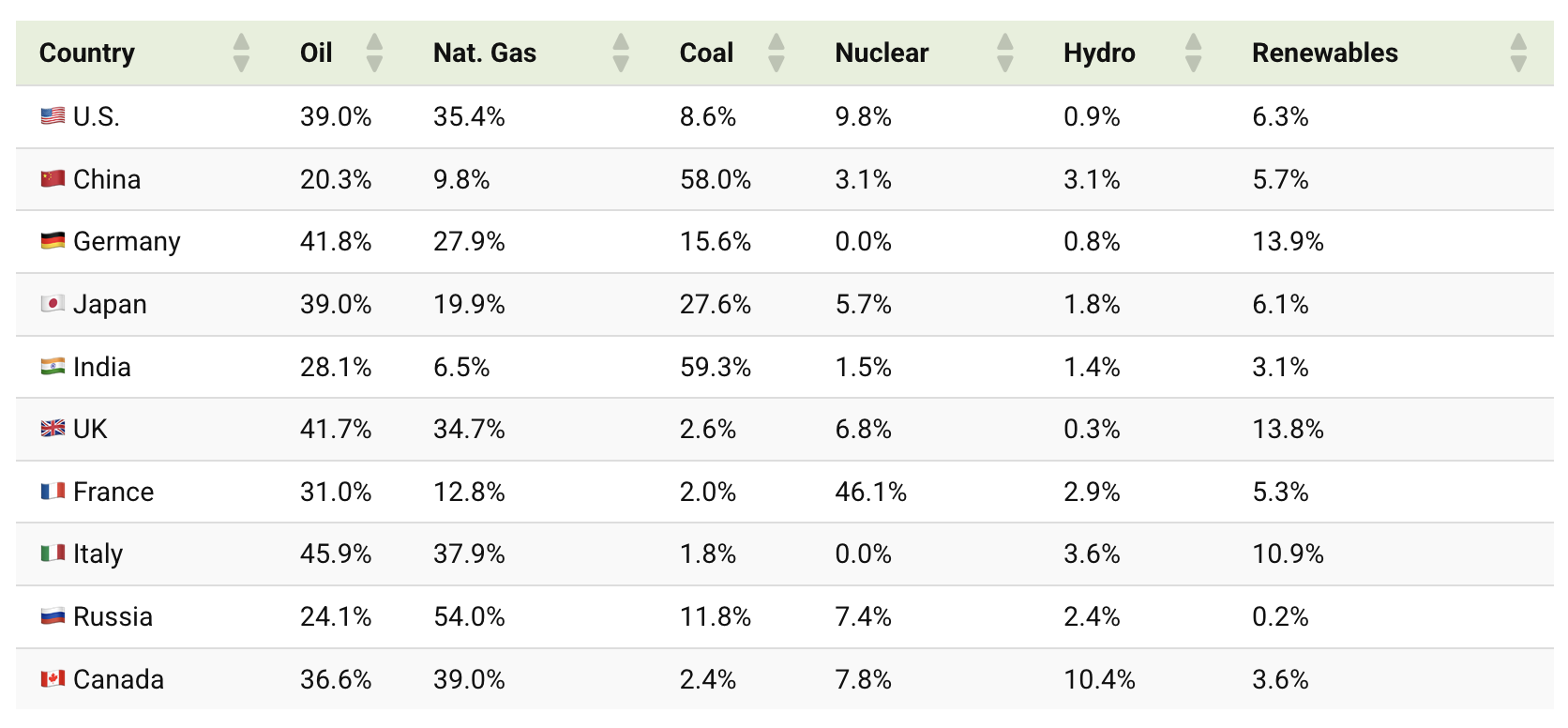
Oil remains the leading energy source in six of the world’s ten largest economies, including the United States, Germany, Japan, the United Kingdom and Italy. Its dominance is largely driven by its critical role in transport and industrial activity.
Among these markets, Italy is the most oil-reliant, with close to 46% of its energy mix coming from petroleum. Germany and the UK also maintain significant dependence, although both have made notable progress in expanding renewable capacity in recent years.
The data above highlights the energy mix across the world’s top 10 economies, illustrating how oil continues to play a central role, even in countries with ambitious climate targets. Despite ongoing transition efforts, its position within global transport systems makes it particularly difficult to replace in the near term.
Coal remains central in China and India
Coal continues to underpin the energy systems of the world’s two most populous economies. It accounts for approximately 58% of China’s energy supply and around 59% in India.
This heavy reliance is closely tied to both countries’ large-scale industrial activity and the availability of domestic coal reserves. As a result, coal remains a cost-effective and dependable source for electricity generation and manufacturing.
That said, both nations are investing heavily in renewables and nuclear power as they work to balance continued economic growth with emissions reduction targets.
Diverging routes to lower-carbon energy
While some economies are accelerating renewable deployment, others are leveraging nuclear and hydropower as key components of their transition strategies.
France stands out for its strong reliance on nuclear energy, which contributes more than 46% of its total energy mix. Canada, by contrast, benefits from significant hydropower resources, with hydro accounting for over 10% of supply, alongside a relatively balanced mix of oil and natural gas.
Russia presents a different profile, with the lowest share of renewables among the group at just 0.2%. Its energy mix is heavily weighted toward fossil fuels, particularly natural gas, which makes up more than half of total supply.
That said, both nations are investing heavily in renewables and nuclear power as they work to balance continued economic growth with emissions reduction targets.
Implications for data centres and the energy transition
These evolving energy mixes have direct implications for power-intensive sectors such as data centres, where demand for reliable, scalable energy continues to surge. As digital infrastructure expands, operators are increasingly prioritising access to low-carbon and stable power sources, driving greater alignment with renewable energy, nuclear, and hydro-backed grids. However, in markets still heavily reliant on fossil fuels, particularly coal and natural gas, balancing sustainability targets with energy security remains a key challenge. This dynamic is accelerating investment in renewable capacity, grid modernisation, and energy storage, positioning data centres as both a major driver of demand and a catalyst for the global energy transition.

